
Your Water Meter is Counting Air.
You’re paying for it.
Smart Valve™ helps qualifying commercial sites evaluate metered water savings. No upfront cost to assess. No electricity required. Request a site-specific review.
Free assessment. No obligation. Qualifying projects receive a written 15% minimum-savings guarantee under a written performance agreement.
10-year manufacturer warranty · No routine maintenance

The proof is in the numbers.
Case studies include project-specific reported results; measurement and verification details are identified with each study.
Explore published project context at our Project Results · Review commercial performance data in the Smart Valve™ performance data sheet
Stop Paying for Air in Your Water

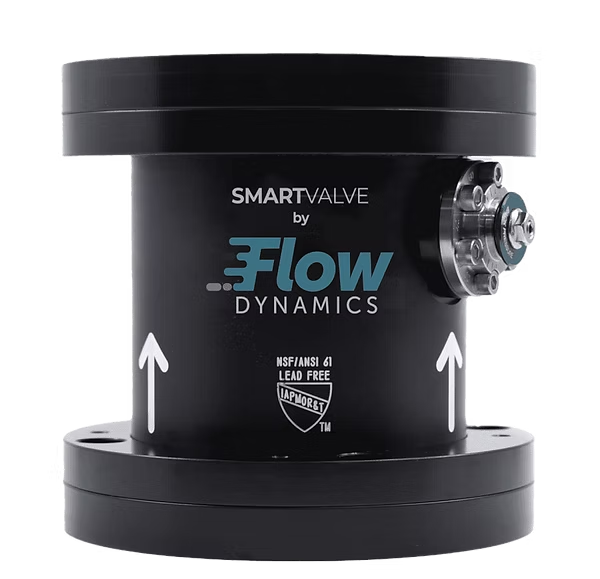
Installed on the customer side of the meter — compresses air in the compression zone before it's billed. Regulated flow exits to your facility.
For terminology explained in a commercial-property context, see What Is Smart Valve™? Smart Valve terminology guide for commercial properties.
And Here's What Most People Don't Realize
Some municipalities calculate a variable sewer charge from water-meter usage. When your account uses that formula, a lower metered reading may lower that variable sewer charge. Fixed fees, minimums, tiers, seasonal or winter-average calculations, caps, and separate sewer meters can produce a different result.
Illustration only: if both line items vary directly with metered consumption, a facility spending $8,000/month on water and $6,000/month on sewer would see approximately $1,600 and $1,200 in lower variable charges from a 20% reduction. Actual savings depend on the account's rate structure.
Sewer billing methods vary by municipality. We recommend confirming your local billing structure as part of the free assessment.
Learn more about sewer savings →Is your commercial property experiencing any of these water system problems?
These are questions property managers, facility directors, and building owners may ask about their water systems. If any sound familiar, a site-specific review can help identify which factors apply. Learn how Smart Valve™ is assessed →
Why did my water bill suddenly spike with no change in usage?
A spike can reflect leaks, operating changes, utility rates, meter timing, or site-specific pressure and flow conditions. Bills provide a starting point, but the cause requires review of the property and its operating history.
Is 80+ PSI normal for my building's water pressure?
Acceptable pressure depends on the building, code requirements, fixtures, and connected equipment. The facilities team should compare measured conditions with the requirements for that specific system.
What's causing the banging sound in my pipes when water is turned off?
Banging may indicate water hammer or another plumbing condition. A qualified professional should inspect the system; Smart Valve™ may help moderate supply-side pressure and flow fluctuations but does not replace required plumbing controls.
Why do I keep replacing seals and gaskets in my fixtures?
Seal and gasket wear can reflect pressure, age, chemistry, installation, equipment duty, or other site conditions. Inspection is needed before attributing failures to any one factor.
My water meter reading seems higher than what we actually use — why?
Differences can reflect billing periods, leaks, operating patterns, meter configuration, and site-specific supply conditions. Meter behavior and entrained-air effects must be evaluated at the property rather than assumed from a bill.
How do I evaluate a high water bill from the utility company?
Review billing periods, rates, meter data, occupancy, equipment use, and leak history with the appropriate utility and facilities teams. A Smart Valve™ assessment can evaluate site fit; measured savings vary by project and period.
What causes unexplained water usage spikes on a vacant property?
Check for leaks, irrigation, maintenance activity, billing-period differences, and meter or service conditions. Bills alone cannot identify the exact cause, and low occupancy does not guarantee a particular Smart Valve™ result.
Can high water pressure contribute to leaks I can't find?
Pressure can contribute to plumbing wear, but acceptable limits and failure causes depend on the installed equipment and system. A site inspection is needed; Smart Valve™ helps moderate fluctuations but is not a leak repair.
If any of these questions apply, upload your last 12 months of water bills for an initial review. Billing history can help identify patterns and guide a site-specific assessment; it does not by itself establish an exact cause or guarantee Smart Valve™ suitability.
Upload Your Water BillsCommercial Sites We Assess
About $5,000 or more per month in combined water and sewer charges is a normal screening level. Published results vary by site and measurement period.
Data Centers
Cooling-water OpEx · facility-specific assessment
Hotels & Hospitality
Property-specific measures, periods, and methods
Car Washes
Caliber overall daily-use result; matched-month measure reported separately
Multifamily
Property-specific measures, periods, and methods
Hospitals
RWJ Barnabas published result; review its source period
Industrial
Industrial fit requires its own facility assessment
AWS reports 40,000+ Smart Valve installations in North America. Published studies. Results vary.
Deployed at scale across North America — with selected customer results and published case studies describing their measurement periods and methods. View all case studies →
Published YYZ3 customer result for Q3/Q4 2024; review the case study for periods and method.
AWS reports ~$27,000 annual avoided cost at current tariffs. Review the case study for the source period and method.
Published customer result; review the case study for source, period, and method.
Supplier-reported annual savings estimate. Review the case study for source and context.
13M+ gallon/year property. Doug Horn, GM verified. Self-reported testimonial.
five installations/sites. 20% average overall daily-water-use reduction; 23% weighted matched-calendar-month savings. Results varied by site.
Published portfolio result; property-specific periods, methods, and sources vary.
6 Smart Valve installations. 31% Pre/Post Average (volume-weighted), 34% Month-to-Month matched-pair. 5 of 6 sites above 25%. Two M&V methods converge within 3 percentage points. Source: American Water Savings.
18% reduction across 4 meters. 7,200 gal/day saved. $2,559.24/mo savings vs. $541.18/mo program cost. 473% ROI. Early M&V (2 months post-install). Source: American Water Savings.
Enterprise Partners (No Public Stats)
The Promise Is in Writing
Qualifying projects receive a written 15% minimum-savings guarantee under a written performance agreement. The guarantee applies to eligible savings under that agreement, not net take-home savings after fees.
Verified Amazon YYZ3 Q3/Q4 average: 43.98% (year-over-year M&V)
Get the Guarantee — Free AssessmentCommon Questions About Commercial Water Savings
Clear, factual answers about how Smart Valve™ works, what to expect, and what the guarantee actually covers.
Request Your Free Assessment
Tell us about your facility and we'll calculate your estimated savings before the first site visit. No obligation.
Request a no-obligation assessment to review your site and water bills.